A supplier portal helps manufacturers reduce procurement costs by keeping purchase orders, supplier commitments, and ERP data aligned after an order is issued. The strongest portals do more than give suppliers a place to view documents. They create a controlled process for acknowledging orders, reviewing date or quantity changes, updating delivery commitments, and identifying exceptions before they affect production.
For manufacturers, the financial value appears in: fewer expedites, lower safety stock, fewer pricing discrepancies, less time spent chasing updates, and fewer production surprises ultimately protecting revenue, margin, and cash flow.
Where Hidden Supplier-Management Costs Appear
Hidden costs are expenses that do not appear directly on the balance sheet but have a real impact on margins. In supplier management, these often arise from manual supplier communications, including emails, spreadsheets, and phone calls, as well as fragmented ERP updates that fail to capture real-time changes. When procurement teams rely on manual processes, common sources of hidden costs include:
- Expedited freight fees due to missed or delayed orders
- Price variances from untracked changes or miscommunications
- Excess inventory held to protect against late parts and production delays
- Payment errors, such as duplicate or incorrect invoices
These issues are proven by customer feedback. One customer reported, “We saw a 32% reduction in buffer stock after implementing automated supplier communications.” Another shared, “Before automation, up to 50% of our supplier invoices had discrepancies due to manual entry errors.” These examples show how invisible costs can accumulate, quietly undermining cost control and introducing unpredictable risk into working capital management.
For CFOs, the challenge goes beyond identifying these costs. Quantifying their impact can be difficult, since manual processes often obscure the true scale of the problem. This makes it hard to validate the ROI of automation or make informed decisions about working capital allocation. Finance leaders are then left managing unexpected cash flow swings and struggling to keep procurement costs from spiraling out of control.
The Real Impact on Profitability and Working Capital
The hidden costs of manual supplier management rarely arrive as one clean line item. They accumulate across handoffs.
A buyer waits for a purchase-order acknowledgement. A supplier sends an updated date in an email. The buyer sees the message but is pulled into another exception. Planning runs MRP against the original date. Operations learns about the delay when a part is already short. The team then pays for expedited freight, changes the production schedule, or carries more inventory the next time to protect against a repeat.
Each decision is understandable. The problem is structural: the supplier commitment and the ERP plan drifted apart.
Common costs include:
- Premium freight and expedites used to recover from late or unexpected deliveries.
- Excess inventory held because planners do not fully trust open-order dates.
- Purchase price variance created when price changes are not reviewed before receipt or invoicing.
- Production disruption caused by parts that arrive later, earlier, or in different quantities than expected.
- Buyer labor spent collecting acknowledgements, reconciling spreadsheets, and searching email threads.
- Invoice exceptions created when the purchase order, receipt, and invoice no longer agree.
- Missed customer commitments when inbound supply issues reach the production schedule too late.
The cost is not only the time required to send another reminder. It is the work buyers cannot do while they are chasing supplier acknowledgements: reviewing price changes, managing shortages, developing alternate sources, and coordinating the exceptions that affect customers.
7 Supplier Portal Benefits for Manufacturers
1. Earlier Visibility Into Late or Unconfirmed Orders
Until the supplier acknowledges the date, quantity, and price, planning is working from intent rather than confirmation.
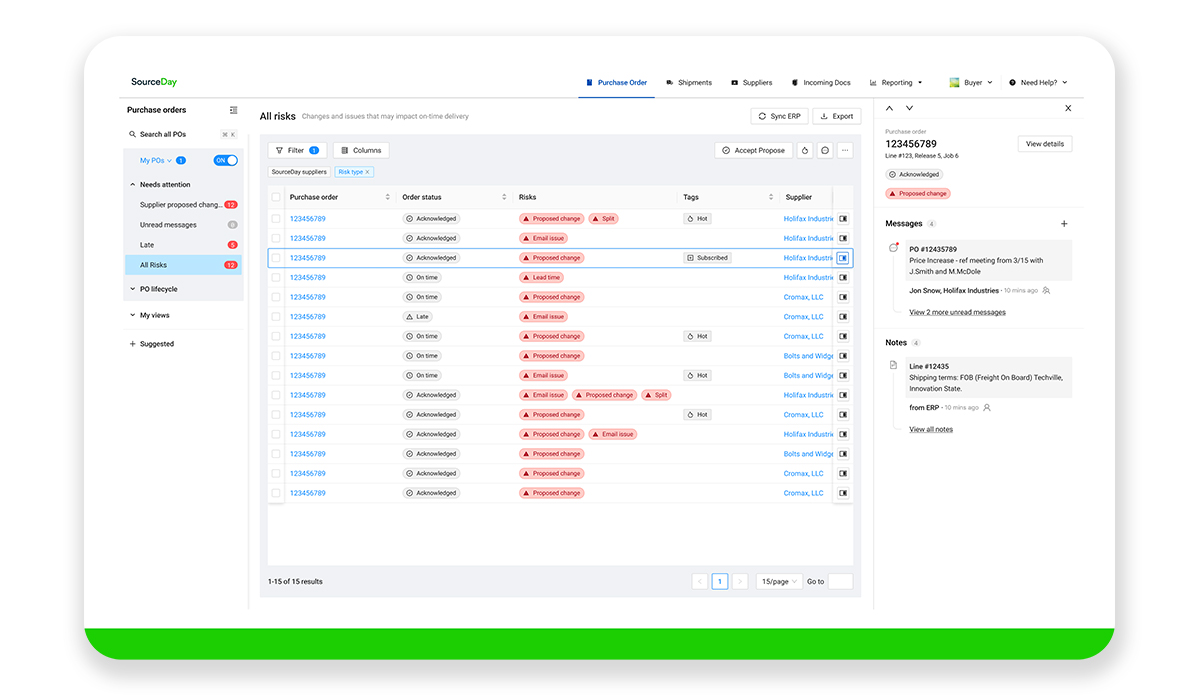
A supplier portal makes unacknowledged orders visible and creates a structured follow-up process. It also gives buyers a clear view of proposed date changes, short quantities, and other exceptions that require a decision. Teams can respond while options remain available instead of learning about the issue at the receiving dock or production line.
Earlier visibility does not eliminate change. It gives procurement, planning, and operations more time to manage it.
2. Lower Expedite and Production-Recovery Costs
Expedites are not isolated transportation decisions. They are frequently the final step in a longer information failure.
A supplier missed an acknowledgement. A move-out remained in email. The ERP still showed the requested date. By the time the gap became visible, premium freight was the least expensive remaining option.
A supplier portal reduces that pattern by tracking confirmations and changes against the purchase order. The financial benefit comes from creating more time to reschedule, use available inventory differently, adjust a build sequence, or resolve the supplier exception before emergency freight is required.
3. Less Safety Stock Tied Up in Uncertainty
Manufacturers often carry inventory to protect production from unreliable supplier dates. That buffer ties up cash and warehouse capacity.
Current confirmations, realistic lead times, visible date changes, and reliable supplier-performance data give planning and finance a stronger basis for lowering selected buffers. SourceDay’s guide on how to reduce safety stock without increasing stockout risk explains how to segment parts and stabilize planning inputs before changing inventory policy.
A portal does not make safety stock unnecessary. It helps teams identify where extra inventory is compensating for poor information rather than real demand or supply variability.
4. Fewer Pricing Discrepancies and Invoice Exceptions
Material costs move. Surcharges appear. A supplier requests a revised price. The risk is not the existence of a change; it is an unstructured approval process.
When a supplier proposes a price change through a controlled workflow, the buyer can review it before it updates the ERP. The business gains an audit trail showing what changed, who approved it, and when the decision occurred.
That reduces the chance that accounts payable discovers the disagreement only after an invoice arrives. It also gives finance better visibility into purchase price variance before it reaches the period close.
5. More Reliable ERP and MRP Data
An ERP can only plan against the information it contains. When supplier commitments change outside the system, the ERP becomes a record of the original plan rather than current execution.
A connected supplier portal closes that gap. Approved dates, quantities, prices, and delivery updates can be synchronized with the ERP so planning works from current commitments. This is why MRP accuracy depends on current supplier commitments, not only accurate demand forecasts and well-maintained item masters.
Better data improves the quality of decisions across procurement, planning, operations, receiving, sales, and finance. Each team sees the same commitment rather than maintaining its own version in a spreadsheet or inbox.
6. More Buyer Capacity Without Losing Control
Routine follow-up consumes time in small increments. One acknowledgement reminder may take only a few minutes. Repeating that work across hundreds or thousands of open lines can absorb a large part of the buyer workday.
A supplier portal can automate standard reminders, track responses, and elevate the orders that need human attention. Buyers still make the decisions that require judgment: accepting a new date, challenging a price increase, escalating a shortage, or coordinating a production response.
The objective is not automation for its own sake. It is a more controlled division of work. The system handles repeatable follow-up, while buyers manage exceptions and supplier performance. Teams can use a buyer productivity audit to identify how much capacity is currently consumed by searching, reminding, rekeying, and reconciling.
7. Stronger Supplier Accountability and More Useful Performance Data
Supplier-performance conversations are difficult when the underlying data is incomplete or disputed. A supplier portal creates a consistent record of acknowledgements, response times, confirmed dates, changes, and delivery performance.
That record helps buyers and suppliers work from the same facts. Instead of debating which email contained the latest date, they can review a visible history of commitments and outcomes.
The goal is not to criticize suppliers. Suppliers also deal with changing capacity, material availability, transportation constraints, and requirements from many customers. A shared process makes expectations clearer and reduces the back-and-forth required to keep orders current.
How a Supplier Portal Reduces Procurement Costs
A useful supplier portal ROI calculation starts with the costs already created by unreliable open-order information. Avoid counting every procurement expense. Focus on the categories the portal can reasonably influence.
Annual avoidable cost = expedite and premium-freight costs + excess inventory carrying cost + preventable price variance + invoice-exception labor + buyer follow-up labor + attributable production-disruption cost.
Then compare the annual avoidable cost with the software, implementation, supplier-activation, and internal change-management costs.
| Cost area | Baseline measure | Portal-related indicator |
|---|---|---|
| Expedites | Annual premium-freight spend and expedite count | Late changes identified before the recovery window closes |
| Inventory | Safety stock, days of supply, and carrying cost | Confirmed dates and lower supplier lead-time variability |
| Pricing | PPV approvals, invoice discrepancies, and credits | Price changes reviewed before ERP update and invoicing |
| Buyer labor | Hours spent on reminders, spreadsheets, and re-entry | Automatic follow-up and exception-based work queues |
| Production | Shortages, schedule changes, and downtime tied to purchased parts | Unacknowledged or late orders surfaced earlier |
ROI should be measured as a range rather than a single optimistic number. Use a conservative case, an expected case, and a higher-value case. This helps finance distinguish measurable savings from benefits that are directionally valuable but harder to isolate.
What Supplier Portal Benefits Look Like in Manufacturing
- Ag Leader: 32% Less Inventory and 99% Customer On-Time Delivery: Ag Leader, a precision-agriculture technology manufacturer using Epicor, improved customer on-time delivery from 76% to 99%. The company also reduced inventory by 32%, freeing millions in working capital, while reaching 100% adoption among strategic suppliers.
- BraunAbility: 22% Less Inventory and 98% Fewer PPV Approvals: BraunAbility, which manufactures mobility equipment and uses Epicor Kinetic, reduced inventory by 22% and avoided a planned warehouse expansion. It also reported 98% fewer purchase price variance approvals and improved on-time delivery from roughly 60% to more than 90%.
- JBT AeroTech: Missing Parts Fell From 31% to 8%: JBT AeroTech reduced missing parts at production start from 31% to 8%. Supplier parts arriving on time improved from 68% to 89%, and customer on-time delivery improved from 69% to 89%. The company also reduced inventory associated with one supplier from more than $1 million to about $200,000, an $800,000 difference.
What Should Manufacturers Look for in a Supplier Portal?
A manufacturer evaluating supplier portal software should ask how the system handles the work that begins after the PO is sent.
- Purchase-order acknowledgements: Can the system show which orders and lines remain unconfirmed?
- Structured change control: Can suppliers propose date, quantity, and price changes for buyer review?
- ERP connection: Do approved updates flow back to the ERP without duplicate entry?
- Exception visibility: Can buyers prioritize the orders most likely to affect production, inventory, margin, or customers?
- Audit history: Is there a visible record of requests, responses, approvals, and changes?
- Supplier adoption options: Can suppliers participate in ways that fit their operating capacity rather than relying on one rigid process?
- Performance measurement: Can the team track acknowledgement, responsiveness, date reliability, and delivery outcomes?
- Buyer control: Is automation visible and governed, with buyers retaining authority over exceptions?
SourceDay’s supplier portal for manufacturers is designed around active purchase-order collaboration rather than static document access. It connects supplier confirmations and changes with the ERP, while maintaining buyer oversight. SourceDay also maintains ERP partnerships and certified integrations across Acumatica, Epicor, Infor, NetSuite and 100+ other environments.
How to Start With Less Rollout Risk
The lowest-risk move is not to automate every procurement process at once. Start by making open purchase orders more reliable.
- Establish the baseline. Measure acknowledgement time, late changes, expedite activity, buyer follow-up hours, PPV approvals, and inventory tied to unreliable supply.
- Choose a contained scope. Begin with a plant, buyer group, supplier segment, or set of high-impact purchased parts.
- Connect the ERP. Define which supplier responses can update automatically and which require buyer approval.
- Activate suppliers with clear expectations. Explain how orders, changes, and responses will be handled and where suppliers receive support.
- Stabilize open-order data. Focus first on acknowledgements, confirmed dates, quantity changes, and exceptions.
- Review results before expanding. Compare operational and financial measures with the baseline, then extend the process where the evidence supports it.
This approach keeps the first step practical. It creates visibility before broader automation and gives procurement, planning, operations, finance, and suppliers a shared operating process.
FAQs
What is a supplier portal?
A supplier portal is a digital environment where suppliers and buyers exchange and manage purchase-order information. In manufacturing, it should support acknowledgements, delivery commitments, date and quantity changes, price reviews, and a current record of open-order status.
What are the main supplier portal benefits for manufacturers?
The main benefits are earlier visibility into order risk, fewer expedites, more reliable ERP data, lower inventory tied to uncertainty, fewer price and invoice discrepancies, more buyer capacity, and stronger supplier-performance accountability.
How does a supplier portal reduce procurement costs?
It reduces costs by identifying unconfirmed or changing orders earlier, limiting manual follow-up, keeping approved supplier updates connected to the ERP, and creating a controlled record of date, quantity, and pricing decisions. These capabilities can influence premium freight, inventory carrying costs, PPV, invoice exceptions, buyer labor, and production recovery.
Does a supplier portal replace an ERP?
No. The ERP remains the system that supports planning, purchasing, inventory, financial, and operational records. A supplier portal extends the process beyond the company by collecting supplier commitments and keeping approved changes aligned with the ERP.
What is the difference between a basic vendor portal and purchase-order collaboration?
A basic vendor portal may provide document access, invoice submission, or order visibility. Purchase-order collaboration manages the ongoing commitments behind an order, including acknowledgement, changes, approvals, delivery updates, and exception handling. The distinction is whether the portal only displays information or helps keep the plan aligned with current supplier execution.
How should a manufacturer calculate supplier portal ROI?
Start with annual expedite costs, excess inventory carrying cost, preventable PPV, invoice-exception labor, buyer follow-up labor, and production disruption attributable to purchased-part uncertainty. Compare a conservative portion of those costs with the total cost of the portal, implementation, integration, supplier activation, and internal change management.
How can manufacturers improve supplier adoption?
Set clear response expectations, make participation straightforward, explain the benefit to suppliers, provide support during activation, and avoid forcing every supplier into the same interaction model. Adoption should be measured through acknowledgement rates, response time, active supplier coverage, and the percentage of open-order updates captured through the controlled process.
Turn Open Purchase Orders Into Commitments the Business Can Trust
The most valuable supplier portal benefits for manufacturers come from reducing the gap between the ERP plan and what suppliers can actually deliver. When acknowledgements, dates, quantities, pricing, and changes stay current, teams can act earlier. That creates fewer surprises, stronger cost control, and more predictable production.
Start with the open orders that create the most follow-up, inventory protection, and expedite activity. Establish the baseline, make supplier commitments visible, and measure what changes.
See how SourceDay keeps purchase orders confirmed, current, and controlled.