Epicor Insights 2026 was the biggest Insights event yet, with more than 4,000 attendees in Nashville and nonstop conversations around AI, automation, ERP modernization, and the future of manufacturing operations.
For the SourceDay team, the event reinforced something we’re hearing more and more across the market: manufacturers know their supply chain processes need to evolve, but many are still early in defining what that transformation actually looks like.
Over three packed days, we spoke with supply chain leaders, IT teams, operations professionals, and purchasing organizations all trying to answer variations of the same question:
How do we scale operations without adding more chaos?
AI Was Everywhere, But Operational Reality Drove the Conversations
AI dominated the event agenda, keynote messaging, and product discussions. Headless ERP, supply chain visibility, predictive workflows, and data-driven operations were recurring themes throughout the conference.
But once conversations moved beyond the buzzwords, attendees consistently focused on more practical questions:
- How does this fit into our existing workflow?
- What data is being touched?
- How does this integrate into Epicor Kinetic or Prophet 21?
- How do we improve data accuracy?
- What measurable impact can we expect?
One theme became very clear: accurate, reliable operational data is now foundational. Companies understand that AI is only as valuable as the data feeding it. Without accurate supplier communication, PO visibility, and dependable operational workflows, advanced automation initiatives become difficult to trust.
That alignment plays directly into SourceDay’s value proposition.
Supply Chain Modernization Is Top of Mind, Even If the Strategy Isn’t Fully Defined Yet
One of the most interesting takeaways from the event was the maturity level of many conversations.
A large percentage of attendees weren’t arriving with fully scoped projects or rigid solution requirements. Instead, many teams were still in discovery mode, exploring what modern supply chain operations could look like and trying to understand where they should begin.
The common themes we heard included:
- manual supplier communication
- email-heavy purchasing processes
- scalability concerns
- on-time delivery challenges
- ERP workflow integration
- supply chain visibility gaps
- operational inefficiencies
Many organizations broadly understood they had supply chain pain points, but they hadn’t always mapped those problems to specific operational root causes or technology strategies yet.
At the same time, more mature buyers were already thinking further downstream:
- implementation planning
- workflow integration
- automation adoption
- supplier onboarding
- measurable operational outcomes
- scaling procurement without increasing headcount
That contrast highlighted a market actively moving from awareness into execution.
Manufacturers Are Realizing Manual Processes Don’t Scale
One recurring insight throughout the week was that manufacturers increasingly understand they cannot continue scaling through spreadsheets, email chains, and additional headcount alone.
Several conversations centered around aggressive growth targets and the operational strain that comes with them.
In one particularly memorable discussion, a manufacturing team shared ambitions to dramatically grow revenue over the next several years while recognizing that their current purchasing and supplier communication processes simply wouldn’t support that scale.
The focus wasn’t automation for automation’s sake. It was about operational leverage:
How do we grow without procurement becoming the bottleneck?
That same theme showed up repeatedly throughout the event.
The SourceDay + Epicor SRM Story Resonated
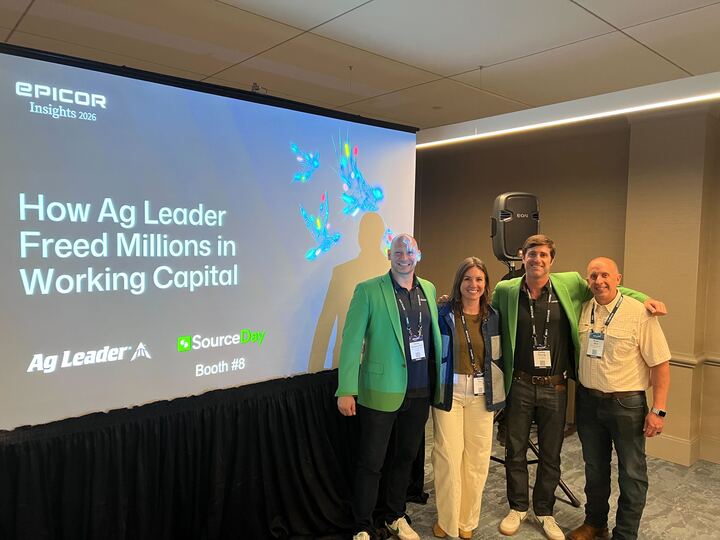
Our joint Epicor Supplier Relationship Management and SourceDay PO Collaboration session was packed and reinforced how important supplier collaboration has become within the broader ERP conversation.
Attendees responded strongly to the operational outcomes discussion:
- automated PO delivery
- automated supplier acknowledgements
- improved supplier collaboration
- improved on-time delivery performance
- better purchasing efficiency
- more accurate MRP data
One standout customer story came from Ag Leader, who shared measurable business impact including:
- 32% inventory reduction
- improvement in customer on-time delivery from 76% to 98%
- enabling purchasing teams to focus on strategic initiatives like QBRs and pricing strategy
- scaling operations with a leaner procurement organization
Those kinds of operational outcomes resonated because they connected modernization efforts directly to measurable business value.
Strong Momentum Around the Epicor Ecosystem
Insights also highlighted growing momentum within the Epicor ecosystem itself.
We had productive conversations with Epicor product teams around roadmap alignment and future enhancements to our Kinetic integration, including areas like ASNs and time-phased visibility.
There was also strong excitement around SourceDay’s launch within Prophet 21, including being highlighted during the P21 roadmap session as part of what’s coming.
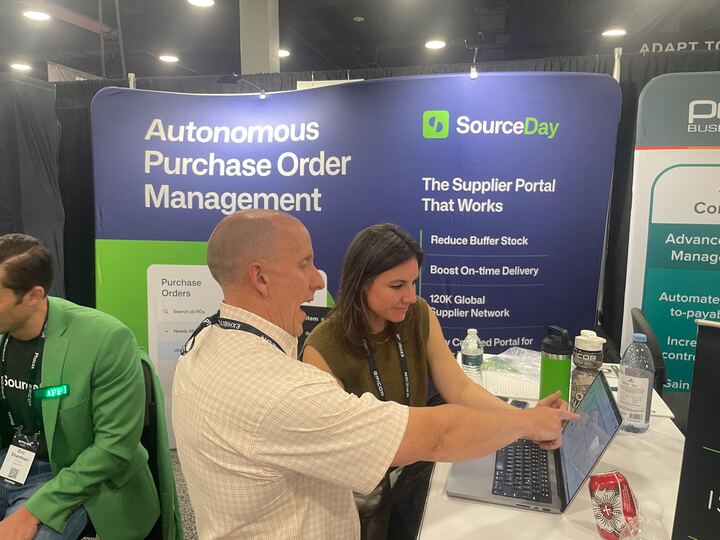
Beyond the sessions themselves, one of the biggest indicators of momentum was simply the volume and quality of conversations happening across the event. The booth stayed busy throughout the conference with customers, prospects, and partners all looking for ways to modernize supplier operations and improve procurement efficiency.
The Market Is Becoming More Competitive
Another important takeaway from the event: the supplier collaboration and procurement automation space is evolving quickly.
Competitors were highly visible and increasingly aggressive in their positioning. Capabilities that once felt highly differentiated are becoming expected baseline functionality across the category.
That’s a sign of a maturing market.
For solution providers, it means differentiation increasingly comes down to:
- operational depth
- ERP integration maturity
- measurable business outcomes
- implementation credibility
- scalability enablement
- long-term partnership value
Manufacturers are no longer just evaluating features. They’re evaluating operational impact.
Final Takeaway
Epicor Insights 2026 showed there’s real energy around supply chain transformation right now.
Manufacturers increasingly understand that operational modernization matters. They know manual processes are becoming unsustainable. They know visibility and data accuracy are critical. And they know AI initiatives depend on having reliable operational foundations in place first.
But many organizations are still early in determining:
- where to start
- what technology stack they need
- how to operationalize transformation successfully
- how to scale without adding operational complexity
The conversations at Insights made one thing clear: the future of supply chain operations won’t be built on more emails and spreadsheets. It will be built on connected workflows, accurate data, supplier collaboration, and scalable operational processes.