If you’re tracking on-time delivery and purchase order changes, Q1 2026 looks like progress. Fewer PO changes. Delivery holding steady. The operational noise quieted down.
Don’t mistake quiet for calm.
What our latest data shows is a shift in where volatility lives — not a reduction in it. On-time delivery risk has come down. Pricing risk has gone up. And unlike last Spring, when tariff uncertainty caused suppliers to hold prices while they waited to see what stuck, that waiting period is over. Costs are moving through the supply chain now.
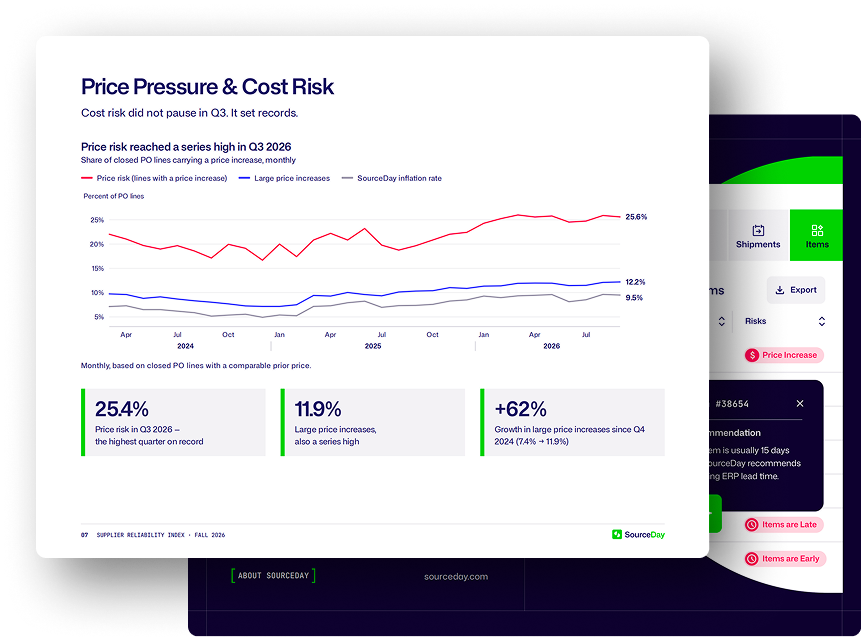
Price Risk Is at Its Highest Level Since 2023

The percentage of items seeing more than 10% inflation is back at levels not seen since the post-pandemic price surge. Manufacturers absorbed cost increases through most of 2025. That absorption is ending.
There’s a harder question underneath this data. Input costs spiked in the first half of 2025, manufacturers caught up in the second half — and now input costs are rising again. Whether they pass those costs through faster this time, or absorb them again, will define margin outcomes for the rest of the year.
The operational signals that used to tell you something was wrong are no longer the most important signals to watch. The risk is financial now, and it’s less visible.
We’ll be publishing the full Q1 2026 Supply Chain Volatility Index next month. In it, we break down where pricing pressure is concentrated, what’s driving supplier behavior shifts, and what manufacturers should do about it.
Volatility Didn’t Disappear in Q1—It Changed Shape
For the past few years, supply chain volatility has been easy to recognize.
Late shipments. Missed dates. Constant purchase order changes. If something was wrong, it showed up clearly in execution.
In Q1 2026, that changed.
At first glance, the data suggests improvement. Fewer purchase order changes. Slightly better on-time delivery. Less day-to-day disruption.
But that surface-level stability is misleading. The reality is more complex—and more important for manufacturers to understand.
The signal is shifting
In our latest Supply Chain Volatility Index, we analyzed real-world purchase order data across direct materials spend.
What we found is not a reduction in volatility. It’s a shift in where volatility shows up.
Execution has stabilized. Pricing has not.
Cost pressure is increasing across supplier networks, even as operational metrics improve. That creates a dangerous disconnect. The easiest signals to track suggest stability, while the most important risks are building underneath.
From disruption to cost pressure
In 2025, volatility was driven by uncertainty.
Buyers and suppliers made constant adjustments to protect themselves from shifting tariffs and unpredictable demand. Nearly half of all purchase orders were changing at peak levels.
That uncertainty hasn’t disappeared. It has been absorbed.
In Q1, fewer reactive changes were needed. But instead of showing up as disruption, volatility is now showing up as pricing behavior. Suppliers are adjusting prices more frequently. Cost increases are being passed through faster. Stability in pricing is becoming harder to maintain.
The question is no longer just:
“Can I get the material?”
It is increasingly:
“At what cost will I get it?”
Why this matters now
This shift changes how manufacturers need to operate. Historically, supply chain risk has been managed through execution metrics:
- On-time delivery
- Purchase order changes
- Supplier responsiveness
Those metrics still matter. But they are no longer enough.
In Q1, on-time delivery improved slightly. Purchase order changes declined. If those are the only signals you’re watching, it’s easy to conclude that conditions are improving.
But pricing tells a different story. And pricing is what ultimately impacts margin.
Volatility is becoming harder to see
One of the most important implications of this shift is visibility. When volatility shows up as late shipments or constant order changes, it’s obvious.
When it shows up as gradual cost increases, pricing variability, and supplier behavior changes, it’s not.
That makes this phase of volatility more subtle—and potentially more dangerous. Because it’s easier to underestimate.
A different kind of risk
What we are seeing now is a structural shift. Logistics and availability are no longer the primary constraints. Execution risk has decreased. Volatility is increasingly driven by economic forces rather than operational disruption.
That means supply chain volatility is becoming a financial problem, not just an operational one. And it requires a different response.
What leading manufacturers are doing differently
The organizations navigating this shift successfully are changing how they interpret risk.
They are:
- Tracking pricing signals as closely as delivery performance
- Monitoring supplier behavior, not just supplier performance
- Focusing on cost visibility at the transaction level
- Aligning supply chain and finance around margin impact
In short, they are adapting to a world where volatility is less visible, but more financially impactful.
The takeaway
Q1 2026 is not a story of stabilization. It is a story of transition.
Volatility didn’t disappear. It evolved.
And the manufacturers who recognize that shift early will be better positioned to protect their businesses from rising raw costs.
Read the full report
This is just a preview of the trends we’re seeing across $5B in direct material quarterly spend across 120K supplier sites..
In the full Q1 2026 Supply Chain Volatility Index, we will break down:
- How volatility drivers have changed over time
- Where pricing pressure is concentrated
- What’s driving supplier behavior shifts
- What manufacturers should do next