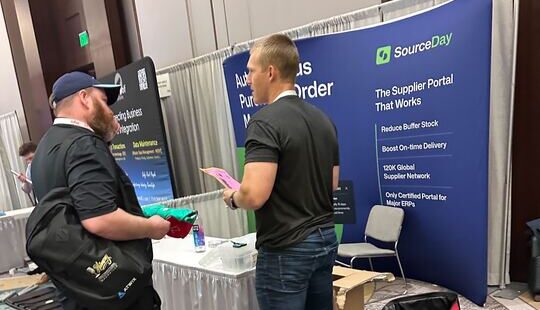
TUG 2026 brought together manufacturers, distributors, and operations leaders for conversations around ERP strategy, finance modernization, inventory management, and supply chain execution.
For the SourceDay team, one theme surfaced repeatedly throughout the event: manufacturers are still struggling with operational visibility and manual purchasing processes that create downstream disruptions across inventory, production, and customer delivery.
Teams are trying to make inventory, forecasting, and production decisions without reliable supplier data.
That challenge showed up consistently across conversations about inventory planning, warehouse operations, invoice accuracy, and supplier communication.
Inventory and Planning Challenges Continue to Create Operational Pressure
One of the most common themes discussed at TUG was the impact that poor supplier visibility has on inventory planning and operational execution.
Many organizations described environments where purchasing and planning teams still have limited insight into supplier delivery timelines, shipment delays, and order status updates. As a result, forecasting and replenishment decisions are often based on incomplete or outdated information.
Several conversations highlighted the downstream effects this creates:
- production schedule disruptions
- shipping delays to customers
- higher safety stock levels
- inventory imbalances
- warehouse inefficiencies
- reactive purchasing behavior
Many teams acknowledged they were carrying additional inventory simply because they lacked confidence in supplier delivery timing and planning accuracy.
That uncertainty creates a difficult cycle. Forecasting and MRP systems can only perform as well as the data feeding them. When supplier updates are delayed or managed manually through email and spreadsheets, downstream planning decisions become less reliable.
Operational Efficiency Remains a Major Priority
Another consistent takeaway from the event was the continued focus on operational efficiency.
Attendees frequently discussed challenges tied to:
- manual purchasing processes
- invoice mismatches
- inventory accuracy
- warehouse management
- supplier communication gaps
- ERP workflow visibility
For many organizations, the focus was less about large-scale transformation initiatives and more about improving day-to-day operational execution.
Teams are looking for ways to reduce manual work, improve visibility, and create more reliable operational processes without adding unnecessary complexity.
Many Attendees Were Still Exploring What’s Possible
One interesting theme throughout the event was that many attendees were still early in evaluating supply chain and procurement technology initiatives.
Several conversations centered less on highly defined projects and more on understanding:
- what solutions are available
- how other manufacturers are approaching modernization
- where operational inefficiencies can be reduced
- how supplier collaboration tools fit into existing ERP workflows
For organizations with active initiatives underway, the focus was most commonly tied to inventory management, finance automation, warehouse operations, and improving supplier visibility.
That exploratory mindset reinforced that many manufacturers are still in the early stages of defining what operational modernization should look like inside their organizations.
The Infor Ecosystem Is Highly Relationship-Driven
Another clear takeaway from TUG was how relationship-driven the Infor user community continues to be.
Several attendees shared that recommendations from Infor representatives, implementation partners, and consulting firms strongly influenced which vendors they evaluated and which sessions they attended.
In some cases, attendees specifically mentioned being directed toward SourceDay by partners or Infor contacts. Others were evaluating replacement options for existing supplier collaboration platforms and attended sessions to better understand available alternatives.
That dynamic reinforced how important ecosystem credibility and partner alignment are within the TUG community.
At the same time, the event also highlighted that awareness around SourceDay within the Infor space is still growing. Many attendees were learning about the platform for the first time and trying to understand how it fits operationally within purchasing and supplier collaboration workflows.
Practical Operational Conversations Resonated Most
One of the clearest takeaways from the event was that attendees responded most strongly to practical operational discussions.
The conversations that gained the most traction focused on:
- supplier delivery visibility
- inventory accuracy
- invoice mismatch reduction
- warehouse efficiency
- ERP integration workflows
- reducing manual purchasing work
Rather than looking for overly aggressive transformation messaging, most attendees wanted to understand:
- how workflows actually function
- how supplier communication improves
- how data quality impacts planning
- how operational disruptions can be reduced
- how quickly measurable improvements can happen
That practical orientation mirrors broader trends across manufacturing and distribution right now. Teams continue to invest in operational improvements, but they are prioritizing visibility, reliability, and efficiency before pursuing larger transformation initiatives.
Final Takeaway
TUG 2026 reinforced that manufacturers and distributors continue to face many of the same operational challenges that have been building across the industry for years: limited supplier visibility, manual workflows, planning uncertainty, and increasing pressure on lean teams.
What stood out most was how interconnected these problems have become.
Supplier delivery uncertainty impacts inventory. Inventory impacts production planning. Planning impacts customer delivery performance. And when teams lack reliable operational data, every downstream process becomes harder to manage.
Manufacturers are actively looking for ways to improve efficiency and gain better visibility across purchasing and supply chain operations. But many are still early in determining what technology, workflows, and partnerships will help them get there.
The conversations at TUG made one thing clear: operational trust and visibility remain foundational priorities for manufacturers trying to improve performance without adding unnecessary complexity.